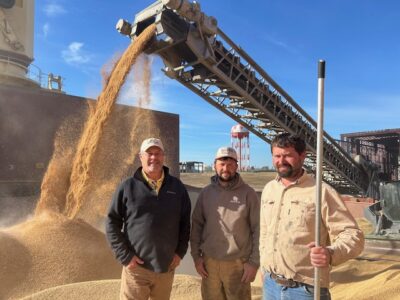
As a child, fifth-generation rice farmer Mark Pousson grew up on the family farm in Jefferson Davis Parish in the Acadiana region of Louisiana. On a typical day, he could be found kicking the dirt and playing with toy tractors while immaculately white, snowy egrets with thin black legs flew gracefully across the bright, blue sky.
“Both my mother’s and my father’s family farmed,” Pousson said. “In addition to that, my wife’s family farms, so farming was all around us when growing up. My family’s legacy of farming rice in this area began with my great-great-grandfather. In fact, I still have his shotgun today.”
When Pousson got out of McNeese State University in 1987, he married his high school sweetheart, Jo Lynn, and they started their own operation.
“As a farmer, rice is all I’ve ever known, and it works well with our crawfish,” he said. “Raising our kids on the farm and watching Madalyn, Marcus, Thomas, and Gabe do the same things we did as children always brought back memories.”
Fast Forward To 2008
In Southwest Louisiana, as Pousson was living the dream watching his family and his crop grow in the lush countryside, he realized that rice markets, along with rice bids, had fallen off, and opportunities for rice farmers to move their crop were bleak.
“When the rice farmers got that ‘no bid’ text from the brokers, we were like, ‘Man, we’ve got a crop in the field and a crop in the bins and can’t do anything with it,’” Pousson said.
What to do? Doing nothing was not an option, he said. When standard operating procedure isn’t working, it’s time to get creative.
A small group of rice farmers in Southwest Louisiana got together to try to figure out how to make something happen. They came up with an idea to send their rice to Mexico via rail. The inspiration for this thought was a rail facility located at the Lacassine Agri-Industrial Park that originally had been intended to carry sugar. Although that venture didn’t pan out, the property, infrastructure, spur, and truck scales were all still there.
Pousson, who is the manager of what is now the South Louisiana Rail Facility (SLRF) in Lacassine, explains how Mike Strain — the Commissioner of Agriculture and Forestry in Louisiana — and Governor Jindal’s administration worked with them to “make something happen.”
“They gave us a long-term lease and helped us get things established,” Pousson said. “But then, the state said we had to ‘put some skin in the game’ before the project could continue. Several presentations were made to groups of farmers, and, based on nothing more than a ‘maybe so and no guarantee’ about 160 farmers contributed roughly $800,000.
“The wonderful thing is that these farmers were standing up for their livelihood,” he added. “The state of Louisiana stepped up to the plate and contributed another $5 million to help build an efficient rail loading facility.”
Can’t Get Rail Cars
The business model, based on shipping rough rice to Mexico via rail, was enjoying a successful run until it hit a snag in 2015. The SLRF couldn’t get any rail cars when the fracking oil industry began paying more money for rail cars to take fracking equipment to North Dakota.
“We had contracts with producers getting a 20 percent margin to the market, and all of a sudden, we just couldn’t get any rail cars and contracts were cancelled,” Pousson said.
However, when one door closed, another door opened when SLRF’s customers asked if they had access to a vessel terminal. At the time, a vessel terminal was being built at the Port of Lake Charles, which is just 30 minutes away from the rail facility.
“We got lined up and loaded the very first vessel out of that terminal with nobody helping us, and everyone trying to stop us,” Pousson said. “So the rail facility business model has morphed into loading vessels to go to other markets.
“Once customers knew we could load boats, they approached us asking if we could load some barges for them at the port. Loading a barge is easy. Now, 40-some-odd boats later, we were loading barges to additional barge markets and bidding at the Port of Lake Charles for our own vessel terminal.
“Some of our members, like Board President Don Gauthier, help with the day-to-day whether it’s loading a ship or dumping trucks, and Kyle Todd figures out the insurance and premium coverage.
“Having a barge market and an opportunity to own and operate our own vessel terminal gives us another marketing opportunity.”
Developing Personal Relationships
A significant — and rare — advantage the SLRF enjoys is having a direct, personal relationship with their buyers. This typically doesn’t happen.
“I communicate with the buyer on quality and pricing, so we’ve negotiated most of our inventory direct with that buyer,” Pousson said. “A few weeks ago, we were loading four barges for one of our buyers. He sent four representatives of his team, who actually were able to get on the barge and watch it being loaded.
“We’ve also established our own protocol for quality control, and they could see it for themselves in our lab. When the representatives got back home, the buyer called back and wanted July, August, and September inventory.
“When buyers come to town, I’ll take them out for dinner. I’ll invite a handful of members to come and sit down and just visit with them. Both sides like that, and the members get to know who’s buying their rice.
“Recently, one of our buyers had to come to Houston to look at a piece of equipment. I had a rice sample
I wanted him to look at. I drove two and a half hours to have lunch with him, show him the rice sample, talk for about five minutes and then drive back home. Little things like this really help develop the relationship.
Agricultural Policy Efforts
In addition to his responsibilities as a rice farmer and manager of the SLRF, Pousson is Vice Chairman of the Board of Directors of the U.S. Rice Producers Association. To recognize his vision and relentless work ethic, he was named Rice Farmer of the Year at the 29th Annual National Conservation Systems Cotton & Rice Conference.
Pousson makes several trips to the U.S. Capitol each year to confer with Louisiana’s Congressional delegation about agricultural policy as it relates to rice producers.
“Our lobbyist, Cornerstone Government Affairs, sets up the meetings with delegation or staff, and the board comes up with our talking points as a whole for the industry,” Pousson said.
“We sit down with Senator John N. Kennedy, Senator Bill Cassidy and our Congressmen and women, and we leave that one-pager with them. We want to stay in front of our delegation on the issues relative to the rice industry. During these visits, we’re running, not loafing — from 8 in the morning to 7 at night. It’s a tough schedule.”
Pousson also visits the Louisiana State Capitol in Baton Rouge to be in front of his local politicians on behalf of the rice industry.
Building A Mill, Recovering From Hurricanes
In 2020, the SLRF decided to build a small mill to expand their opportunities in milled rice markets. Today, it’s still a work in progress, but it’s moving forward.
For example, the Louisiana Economic Development agency recently said, “The South Louisiana Rail Facility, an agricultural export and processing company, announced it will invest $2.1 million to further expand its Jefferson Davis Parish operations. The project includes new bagging and warehouse equipment designed to increase efficiency and open new marketing opportunities for Louisiana rice producers.”
SLRF Vice Chairman Ronnie Petre said, “At South Louisiana Rail Facility, we’re not just moving commodities — we’re driving economic growth, strengthening Louisiana’s agricultural industry, and connecting our farmers to global markets. Our commitment to efficiency, innovation, and partnership is what sets us apart.”
In contrast to this good news about the mill making positive strides six years after being constructed, is the memory of how two intense hurricanes — Laura and Delta — showed up in late summer and early fall and wreaked havoc on everything in their path.
“Hurricanes Laura and Delta wiped out rice storage and just devastated Southwest Louisiana,” Pousson said. “Our personal on-farm grain bins were destroyed, too.”
Once again, it was time to think beyond the box and turn the grain bin damage into a positive. To accomplish this, Pousson said, “As a group of farmers, we constructed 10 48-foot grain tanks to help minimize that harvest pressure.”
The Good, The Bad, The Ugly, And The Blessings
Every industry has its share of the good, the bad, the ugly, and the Blessings. Southwest Louisiana rice farms and the SLRF are no different, Pousson said.
“Like replacing the grain bins, securing our own terminal at the port and loading our own vessels, we’re always figuring out a way to make things happen. That’s part of the good. The bad and the ugly are the economics of rice farming and the unfairness of the trade. But knowing what we are doing is helping the bad and the ugly.”
One of the blessings, Pousson said, is that his family and his father-in-law, Phil Watkins, are still farming and still in the area. Another blessing is having been freed from cancer in 2025.
Mark’s son, Marcus, is farming his 11th rice crop this year. His wife, Clair, brings their two little boys over just to see the tractor and play in the dirt. Marcus’s twin sister, Madalyn, and her husband, Garrett Hebert, also farm. Madalyn can walk over with their three children who like to play in the dirt, too.
“The next son, Thomas, is an attorney who helped us with the legal paperwork when we were bidding on the vessel terminal at the port,” Pousson said. “He comes over several nights a week just to have dinner and visit. The younger son, Gabe, farms and comes over for supper most nights when he’s not working.
“Every day, I am inspired by knowing my children and other young farmers always have options and don’t have to fight so hard for what we have to have. That puts it all in perspective.” ∆
We use cookies to ensure that we give you the best experience on our website. If you continue to use this site we will assume that you are happy with it.