Wednesday, April 1, 2026

Market Update

SCOTT STILES HARRISBURG, ARKANSAS

These days you look for good news wherever you can find it.  September rice futures have pushed higher over the past month, rallying about $1.15/cwt. from the February lows.  That’s about where the good news ends.  The rally is running into strong resistance at $12 this week (basis the September contract).  In trading early Friday morning, we were seeing that resistance hold with the market pulling back about 27 cents.

Figure 3.  September 2026 Rice Futures, Daily Chart.
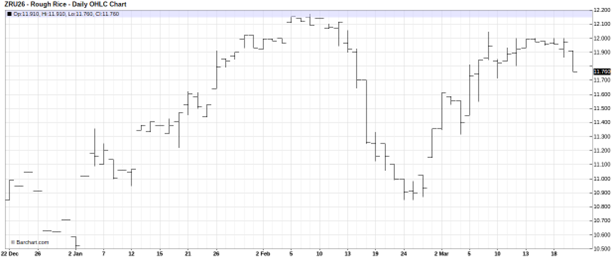
September 2026 Rice Futures, Daily Chart

In Monday’s Crop Progress, Louisiana was the only state showing up with rice planted.  They are off to the races according to NASS with 45% planted v. 16% last year and 16% on average.  Some planting is getting underway this week in Arkansas.

In Thursday’s Export Sales, USDA reported net sales of 34,246 tons of long-grain rough rice and 11,500 tons of milled rice in the week ending March 12th.  Honduras, Mexico, and Guatemala were the top rough rice buyers for the week.  Rough rice shipments of 31,695 tons were the highest since last November.  In total, cumulative ‘25/’26 long-grain sales remain about 28% behind this time last year.  This is making USDA’s 54 million cwt. export target look more difficult to achieve, especially with South American rice still $80 to $100/ton below the U.S.

Crop Margins

Looking forward, the rice market appears more optimistic for the ‘26/’27 balance sheet as new crop futures are trying to work higher.  Unfortunately, sharp increases in key inputs are more than offsetting the past month’s strength in rice futures.  This is keeping the acreage debate alive.

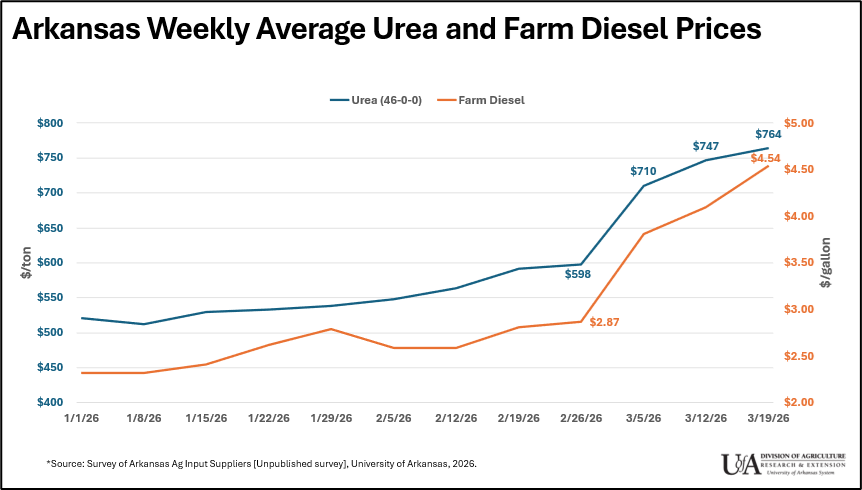
Since the Iran war began, projected 2026 operating margins for all crops have shifted.  How much will the recent increases in Urea and diesel prices affect rice budgets?  Since March 1, the average retail price of Urea has increased about 30% and diesel prices have now increased more than 60%.

Each week, we survey input dealers around the state for fertilizer prices.  Since early March, we’ve seen little movement in potash and phosphate prices.  However, the most significant price changes have occurred in Urea.  The figure below includes a weekly average of Urea and farm diesel prices in eastern Arkansas.

Fig. 4.  Arkansas Weekly Average Urea and Farm Diesel Prices.

Arkansas Weekly Average Urea and Farm Diesel PricesBased on input use estimates in the University’s crop budgets, the recent surge in fuel and fertilizer prices would increase rice production costs by about $97 per acre compared to a month ago.  As mentioned earlier, rice prices have also improved with new crop rice bids up about 26 cents per bushel or about 5% since the end of February.  Assuming a 200-bushel rice yield, the past month’s price gains equate to about $52 per acre—falling short of covering the increases in fertilizer and fuel prices.

Whether fuel and fertilizer prices continue to increase or pull back depends largely on how soon the supply disruptions in the Middle East are alleviated.  For now, we have a problem.  This week, farm organizations across the country, US Rice Producers Association and USA Rice included, sent a letter to the Trump administration proposing a new round of assistance for ag producers as part of a defense supplemental request for funding the war with Iran.  Link: Letter to President Donald Trump.  Farm groups noted that as planting began, “the closure of the Strait of Hormuz sent fuel and fertilizer prices skyrocketing” – further straining the farm economy.

The letter doesn’t specify how much additional money farmers need, but lawmakers have already been discussing $15 billion in new farm aid to supplement the $12 billion Farmer Bridge Assistance Program that USDA funded through its Commodity Credit Corporation spending authority.

Farmer Bridge Assistance (FBA) Update:

As of March 14th, USDA had disbursed almost $292 million in FBA payments to Arkansas producers.  Rice payments made up nearly $144 million (49%) of the total payments since enrollment opened February 23rd.  More information on the Farmer Bridge Assistance Program can be found at this link:  Farmer Bridge Assistance (FBA) Program.   ∆

SCOTT STILES UNIVERSITY OF ARKANSAS

LINK: https://arkansascrops.uada.edu/posts/crops/rice/arkansas-rice-update-3-20-26.aspx

Related Articles

Quick Links

E-News Sign Up

Connect With Rice Farming