When it comes to deciding the direction of my research program, I rely heavily on my extension program to identify the needs of the industry. There’s always going to be unique one-off situations that may not require much time and attention in terms of research because of the narrow impact. However, when I start to receive multiple phone calls regarding the same issue, that tells me there is a wide scale issue that needs to be addressed through research. For example, when I started in this position in 2022, there were not many known options for Fimbristylis control, which was a big topic. A big focus of my program for the first couple of years was on Fimbristylis and we were able to come up with several control options.
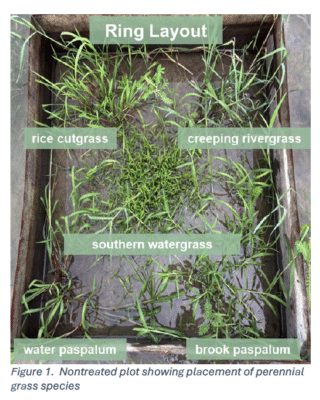
The bulk of my weed control phone calls typically consist of the usual suspects: barnyardgrass, Amazon sprangletop, weedy rice, ALS resistant rice flatsedge, Fimbristylis, alligatorweed etc.; however, in recent years Brook paspalum has risen to the top of the list. In 2025, the Weed Management Program set out to determine the best herbicide options for Brook paspalum as well as several other perennial grasses including water paspalum, creeping rivergrass, southern watergrass, and rice cutgrass.
Before we get into the “how”, let’s talk about the “why”. Why are Brook paspalum and other perennial grasses becoming such a big issue? The quick answer is increasing crawfish acres in conjunction with reductions in tillage. Over the past several years we have seen modifications to crawfish boats such as the basket wheel, the use of air boats, and an increase in using push boats. All of these modifications have led to the reduction in tillage needed in the fall to prep crawfish ponds for rice planting the next spring. Any time we adopt new practices, there is a give and a take. The give in this situation is less labor, time and diesel costs for ground preparation, but the take has been a shift in weed spectrums, specifically to more perennial species.
Perennial grass control will take an integrated management approach to reduce populations. Tillage can be a great tool for perennial grass management, or it can be a detrimental tool. Shallow and inconsistent tillage will result in the fragmentation of the rhizomes leading to the spread of perennial grasses. To manage perennial grass using tillage, frequent deep tillage must be used during dry periods. The rhizome is the lifeline of perennial grass and efforts should be made to starve the rhizome by exposing it under dry conditions. If tillage is incorporated during high soil moisture or in front of rain, the perennial grass will simply re-root.
In late fall, shorter days and decreasThis ensures that the rhizome has enough energy to reestablish itself the following spring. This natural phenomenon can and should be used to our advantage. By applying systemic herbicides, such as glyphosate, in the fall we can piggyback the herbicides with the downward flow in the plants to get more herbicide translocation into the rhizome preventing reestablishment.
Like I mentioned earlier in the article, several trials were conducted in 2025 to evaluate herbicide efficacy in crop for perennial grasses. Below are some of the conclusions from the first year of research. At this time these results are preliminary as these trials are going to be replicated in 2026.
Brook paspalum
Novixid has been my recommendation for Brook paspalum control for the past couple of years and to no surprise Novixid was the most effective herbicide evaluated in 2025. Another option that shows promise is Loyant mixed with Regiment but is a step down from Novixid. In Clearfield rice, Beyond Xtra mixed with Loyant was comparable to Novixid and Beyond Xtra mixed with Grasp was a close second. In Provisia rice, I was surprised with how much activity I saw from sequential applications of Provisia alone. In the past I have always believed that Provisia was not effective on Brook paspalum, which is the case for a single application. However, Provisia applied in sequential applications 10 days apart controlled Brook paspalum 70-80%.
Water paspalum
The quick answer to water paspalum control is to use an ACCase inhibiting herbicide such as Clincher, Ricestar, or Provisia in the Provisia rice system. Beyond Xtra was also effective on water paspalum in the Clearfield system. Synthetic auxins and ALS inhibitors such as Loyant, Facet, Grasp and Regiment did not provide any control of water paspalum.
Creeping rivergrass
Clincher and Ricestar offer some activity on creeping rivergrass but will struggle to control it completely. Grasp, Regiment, or Loyant were the most effective options for creeping rivergrass in a conventional system. For broader spectrum weed control Grasp or Regiment can be mixed with Loyant (Loyant+Grasp=Novixid). Provisia and Beyond Xtra were both effective for creeping rivergrass control in their respective rice systems.
Southern watergrass
For southern watergrass control, Clincher offered some suppression at best. Clincher knocked the southern watergrass back for a couple of weeks but it fully recovered later. Rogue was also evaluated for southern watergrass control but only bleached the southern watergrass for about a week before fully recovering.
Rice cutgrass
There are no options for controlling rice cutgrass in conventional or Clearfield rice. The only time I was able to control rice cutgrass was with sequential applications of Provisia 10 days apart.
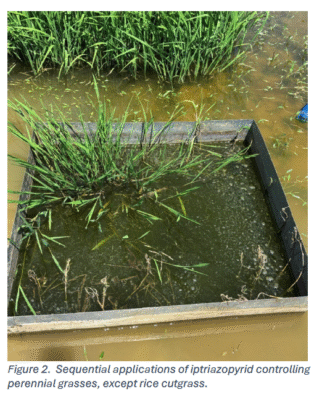
To end on a good note, the Weed Management Program has been evaluating a new active ingredient that is currently being pursued for registration by Gowan USA and Nissan Chemical Corporation. This new herbicide, iptriazopyrid (GXP-70101), is an HPPD inhibitor (bleacher) and will offer broad-spectrum postemergence control of several rice weeds. Iptriazopyrid was evaluated for perennial grass control in 2025 and was found to control all previously mentioned perennial grass species except rice cutgrass (Pictures 1 and 2). ∆
Figure 1. Nontreated plot showing placement of perennial
Figure 2.Sequential applications of iptriazopyrid controlling grass species perennial grasses, except rice cutgrass.
CONNOR WEBSTER AND MARANDA HAINS
LSU AGCENTER
Link to Original Article: https://www.lsuagcenter.com/portals/our_offices/research_stations/rice
We use cookies to ensure that we give you the best experience on our website. If you continue to use this site we will assume that you are happy with it.