
Thursday, September 24, 2026

Specialists Speaking- Dr. Sam Rustom

Dr. Sam Rustom
TEXAS

In Texas, we typically grow two rice crops per growing season. Our first, or main crop, harvest is now complete, with reports of yields and milling being slightly below average due to increased rainfall and cloudy weather during pollination. We are now full steam ahead with our second crop, also called the ratoon crop.

In some parts of the Texas rice belt, we have observed several instances of apical dominance in our ratoon rice regrowth in 2026. This is even happening in fields where stubble was managed properly following main crop harvest. The rains and cloudy weather observed during the main crop reproductive stages are the most likely cause.

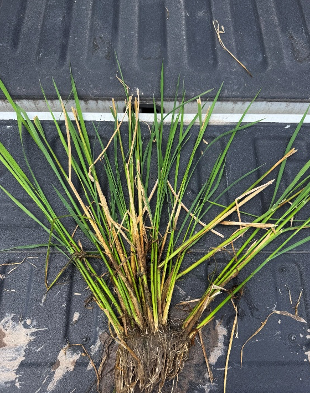
Apical dominance is the biological process where ratoon tillers grow from the upper and/or middle nodes of rice plants rather than the basal nodes. Regrowth from middle and upper nodes is usually weaker, with smaller panicles resulting in lower yield and grain quality (Photo 1). Optimally, we prefer to see regrowth coming from the basal, or lower, nodes of the rice plant (Photo 2). These tillers are typically stronger and produce larger, higher quality panicles.

Photo 1. Severe occurrence of apical dominance near Chesterville, Texas, where ratoon rice tillers were observed originating at the upper and middle nodes.
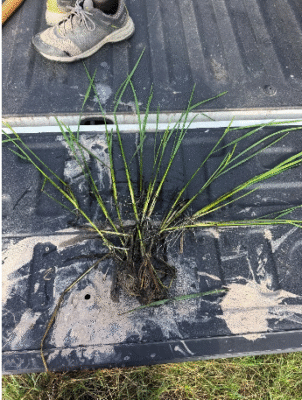
Photo 2. Adequate ratoon rice regrowth from basal nodes near Inez, Texas, which likely received more sunlight during the 2026 main crop.


The mechanism for apical dominance in this year’s situation is fairly straightforward. Excessive rainfall and reduced sunlight during the main crop in 2026 led to a reduction in photosynthetic activity that left less non-structural carbohydrates available in the rice stubble. These carbohydrate reserves are the primary energy source that drives ratoon crop regrowth and development. When non-structural carbohydrate reserves are low in stubble, the resulting regrowth favors apical dominance. Adequate carbohydrate reserves in the stubble are what usually drives the basal tillering that is preferred to maximize yield and quality.

I would be remiss not to mention rice delphacid in a ratoon rice report. It remains the No. 1 pest management concern for Texas rice producers, especially during this time of year. So far, 2026 has been relatively mild compared with the 2025 outbreak. That said, we have observed the insect in most of, if not all, the rice-growing counties across the Texas rice belt this year, but populations have remained relatively stable. In addition, there have been slight increases in rice delphacid activity in recent weeks, but nothing like we saw in 2025. Right now, we are thinking that a stronger beneficial/predatory insect complex in 2026 is part of the reason for this. Keep in mind that we are still learning about this pest, and populations can explode at any time, especially as the ratoon rice gets deeper into the reproductive stages like heading and grain fill.

Related Articles

Quick Links

E-News Sign Up

Connect With Rice Farming