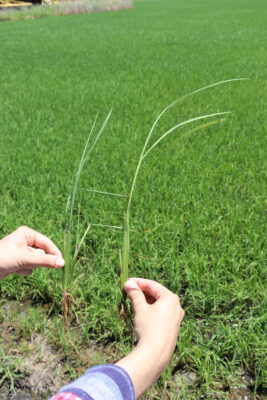
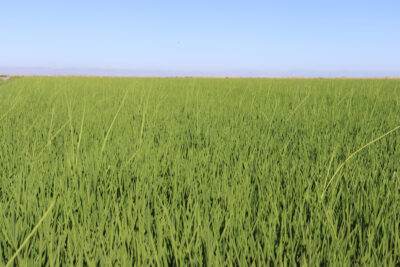
In the past few years, there has been an increase in the incidence of fields infested with bakanae. This disease, caused by a fungus, was first found in California in 1999. Bakanae is a seedborne disease that causes yellowing and elongation of seedlings, eventually killing them. Infected seedlings that survive may show these symptoms later in the season and produce a blanked panicle. At the end of the season, surviving plants produce a pinkish sporulation at the base of the tiller. These spores infest the seeds of healthy plants during harvest. Past research has shown that in California, the fungus does not penetrate the seed itself; the spores are only on the husk. Currently, the level of incidence we are seeing in infested fields has not resulted in yield losses.
Soon after the discovery of bakanae, a seed treatment consisting of a soak in sodium hypochlorite (bleach) was developed. This treatment has been successful in reducing the overall incidence of bakanae. In conversations with some seed handlers, they have indicated that sodium hypochlorite treatment rate is close to 90%. That means that most seed is treated. It would not be surprising to find bakanae in untreated seed. However, many of the fields with bakanae I have visited in the past few years used treated seed. There are a couple of explanations of why bakanae would appear in these fields.
After the sodium hypochlorite soak, the seed is drained so that it can be loaded into trucks and then airplanes. If there is a delay in seeding and the seed has to stay in the truck longer than expected, surviving bakanae fungus spores may produce more spores and result in higher incidence of bakanae. It is unknown how long of a wait in the truck may result in an increase of bakanae, but growers that had to delay seeding one day have seen noticeable increases of bakanae incidence.
Another possible reason for the increase in bakanae may be deviations from the seed treatment guidelines. If the soak is done for a shorter period than recommended, or if the concentration of sodium hypochlorite is not correct, bakanae fungus spores may survive and produce symptoms in the field. We have a bakanae fact sheet with detailed sodium hypochlorite guidelines in our website.
A common question I get is how likely the bakanae fungus is to survive in the soil once it has been introduced into a field. Research from many parts of the world has shown that the bakanae fungus does not overwinter very well in the soil; therefore, the risk of bakanae becoming established in the soil is low. Currently, the best way to reduce the incidence of bakanae is to use the sodium hypochlorite treatment. This ensures that the incidence of bakanae remains low in your field and in the rice production area of California. ∆
LUIS ESPINO
CALIFORNIA
Infected seedling (right) next to healthy seedling.
We use cookies to ensure that we give you the best experience on our website. If you continue to use this site we will assume that you are happy with it.