

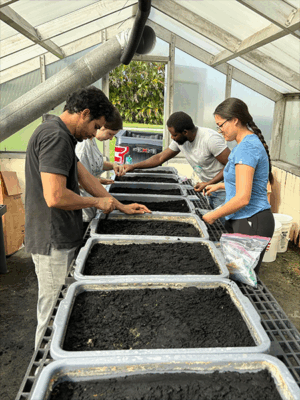
Members of the research team set up the trays in the greenhouse to simulate pre-flooding conditions with Suraj Melkani front left. (Photo provided)
MIKE LOIZZO
GAINSVILLE, FLORIDA
The Everglades Agricultural Area (EAA) boasts organic-rich soil, ideal for farming. Rice producers, however, must deal with phosphorus and iron tightly bound in the soil, making them unavailable to plants. New University of Florida Institute of Food and Agricultural Sciences (UF/IFAS) research may help free those critical nutrients. Scientists in the UF/IFAS Department of Soil, Water, and Ecosystem Sciences (SWES) and their colleagues tested “pre-flooding” the soil before planting rice. The goal was to see if saturating the soil could trigger natural chemical reactions that release both nutrients in plant-available forms.
In a controlled pot experiment, three treatments were compared: no pre-flooding, 15 days of continuous saturation, and a full 30 days of saturation. After the pre-flood period, the researchers drained off the water and planted rice. After shoots emerged, they flooded the pots and maintained conditions typical of rice production. Throughout the growing season, the team measured extractable phosphorus (P) and iron (Fe). They also recorded total soil nutrient pools, soil pH, and acid phosphatase enzyme activity, which makes P available to plants. At harvest, they assessed rice biomass and tissue nutrient content to capture the crop’s response.
Findings
“The results showed a clear advantage for the 30-day soak,” said Suraj Melkani, SWES doctoral candidate. His research focuses on soil carbon stability in the Everglades using machine learning and spectroscopy.
“Extractable P and Fe declined more gradually under prolonged pre-flooding,” he added. “This suggests a steadier nutrient supply for plant growth.”
At the same time, total soil pools of both P and Fe increased. This is most likely because of small inputs from irrigation water and the movement of legacy P within the soil under flooded conditions. The increase is an indication that previously bound reserves mobilized under low-oxygen conditions, most pronounced with 30 days of pre-flooding. Soil pH rose modestly in all treatments but was least variable under 30 days of pre-flooding. Although acid phosphatase activity peaked at planting, its influence waned.
“By harvest, rice grown after a month of pre-flooding produced the greatest above- and below-ground biomass,” said Jango Bhadha, SWES associate professor and Melkani’s faculty adviser. “That treatment also exhibited the highest iron uptake, underscoring the benefit of tapping into the soil’s own nutrients.”
Implications
For growers, adopting a 30-day pre-flooding window could lessen their dependence on commercial fertilizers and cut costs. At the same time, the gradual release of in-field P and Fe reserves supports more consistent plant development.
“Enhancing in-field nutrient availability helps prevent excess P from washing into canals,” Melkani said. “Avoiding such ecological imbalances helps the environment.”
While these pot-scale findings are promising, the team said field-scale validation is needed. That also would allow for different water-management regimes, multiple growth cycles, and naturally occurring events.
“Ultimately, creating pre-flooding guidelines will help advance sustainable rice production on this unique soil in the EAA,” Bhadha said.
The full article, “Pre-flooding phosphorus-iron interactions and nutrient uptake under flooded rice cultivation in histosols of South Florida,” is available on the Journal of Plant Nutrition website. Florida Rice Growers Inc. provided funding support for this research. Additional funding came from the National Science Foundation’s Science and Technologies for P Sustainability (STEPS) Center (CBET-2019435), the USDA NIFA Hatch Fund (FLA-ERC-006097), and the USDA Multistate Hatch Fund (FLA-ERC-006388). The UF/IFAS Everglades Research and Education center (EREC) was the site of the study. ∆
MIKE LOIZZO
UNIVERSITY OF FLORIDA
Link To Original Article: https://blogs.ifas.ufl.edu/swsdept/2025/10/13/rice-fields/