

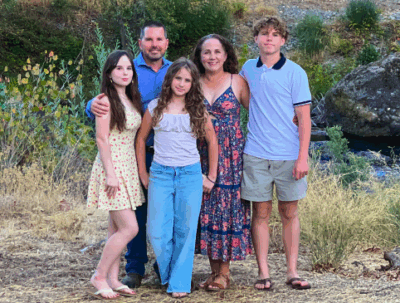
Dr. Dustin Harrell:
2025 Rice Industry Award
Scott McClure
The U.S. rice industry has honored Dr. Dustin Harrell, Director of the California Cooperative Rice Research Foundation’s Rice Experiment Station, with the 2025 Rice Industry Award, sponsored by Horizon Ag and USA Rice.
The award recognizes Harrell’s decades of service to farmers in both the South and California and his far-reaching contributions to advancing rice production nationwide. For Harrell, the recognition is both humbling and personal.
“Receiving this honor means a lot,” he said. “I was excited to find out I had won, and surprised and just honored to be recognized by the rice industry.”
Harrell’s path to becoming one of the nation’s leading rice agronomists was anything but straightforward. He began his career teaching agriculture at the high school level in Texas after graduating from Texas A&M University. Though he taught for only a year and a half, the experience was formative. His students earned district and area officer titles, won state leadership contests and even placed second in the National Science Fair.
But his passion for soil science and agronomy eventually pulled him back to the university classroom. Harrell pursued a master’s degree in soil fertility at Stephen F. Austin State University and later earned his PhD in soil fertility and agronomy at Louisiana State University (LSU).
Between degrees, he spent a year with USDA’s Natural Resources Conservation Service, helping map soils across the famed King Ranch in South Texas.
Rice Beginnings
When the opportunity arose to join LSU’s Rice Research Station in Crowley, Louisiana, Harrell pursued it, despite never having set foot in a rice field before.
“I had worked in forages, fertility and corn, but never in rice,” Harrell recalled. “Dr. Steve Linscombe gave me a chance, and I knew from a soil fertility standpoint that being in a flooded environment was exciting. It’s a more stable system, and you can do things in rice you can’t do in other crops.”
That opportunity proved to be life changing. Harrell began as a research agronomist, later taking on a joint appointment between the station and LSU’s campus. After the retirement of Dr. Johnny Saichuk, he stepped into the role of Rice Extension State Specialist, a position that allowed him to serve farmers across Louisiana. By the time he left LSU, he was not only the extension specialist but also the LSU AgCenter Rice Research Center director.
Throughout his LSU tenure, Harrell earned a reputation for tackling problems head-on and creating solutions that stuck. One of his early achievements was helping to identify “mystery malady” — a zinc deficiency that plagued Louisiana fields — and developing soil-test–based recommendations to address it.
He also pioneered new ways to connect with farmers. At the urging of consultants, he created the Louisiana Rice Text Group, the first of its kind in the state. Initially plagued by technical hiccups, the system eventually became transformational, allowing real-time sharing of yield reports, research findings and urgent field updates.
Harrell credits mentors like Linscombe, Saichuk and Dr. Don Groth with shaping his career. “When you have a good team around you, with similar goals, you can get a lot done,” he said. “All of my accomplishments have been because of the great people I’ve worked with — growers, consultants, county agents and fellow researchers.”
California Leadership
In recent years, Harrell has led the Rice Experiment Station in Biggs, California, which is operated by the California Cooperative Rice Research Foundation. Unlike university-based programs, the station is owned and directed by growers themselves.
“Every grower in California can be a member of the foundation,” he explained. “They own this research station, and they own the varieties we develop. When we release a variety, we’re directly providing that to the growers of California.”
Under his leadership, the station has released several new varieties, including the first aromatic Calrose rice, aimed at expanding domestic markets. Maintaining the world-renowned quality of California Calrose has remained a top priority. His team has also worked closely with mills and marketers to ensure new varieties align with consumer expectations.
Perhaps most exciting has been Harrell’s role in advancing Roxy rice, the industry’s first herbicide-tolerant rice in California. Developed at the station through the discovery of natural resistance to oxyfluorfen by Dr. Kent McKenzie, the project has evolved into a partnership with Albaugh to bring both the trait and herbicide to market. “It’s going to be a game-changer,” Harrell said. “It has the potential to transform rice production and agronomy here.”
Challenges Across Regions
Having worked in both the Southern U.S. and California, Harrell is uniquely positioned to understand the challenges of each. In the South, growers benefit from a wide toolbox of herbicides and seed options. California growers, by contrast, face strict environmental regulations, limited herbicide choices and must manage medium and short grain rice largely for Asian and domestic markets.
“Here in California, if your rice is under stress, you can’t just drain the field like you could in the South because of water-hold regulations,” Harrell explained. “That makes agronomy much more complex.”
Despite these challenges, he emphasizes that farmers, whether in Louisiana or California, share the same values. “Rice farmers everywhere are focused on producing the best crop possible and supporting their families. That’s universal.”
“Typically, when I visit a rice farm, there’s a problem,” Harrell said. “When you can solve that issue, and it makes a difference to the grower, it feels like you’ve really accomplished something. That’s the highlight of my career.”
Gratitude and Thanks
In accepting the Rice Industry Award, Harrell is quick to express gratitude. “First and foremost, my family — for supporting me all these years. I couldn’t do this without them. There’s a lot of travel, a lot of nights away from home, and they’ve always stood by me.”
He also thanked rice growers for their trust, consultants and extension agents for their collaboration and his colleagues across multiple states who have shared research, trials and publications. “I’ve been very lucky,” he said. “I’ve had great mentors and teammates, and together we’ve been able to accomplish a lot.”
Reflecting on his 20-plus years in the industry, Harrell recalled an early memory from a 2005 meeting when fellow researchers Tim Walker, Jason Bond and Brian Otis passionately declared their lifelong commitment to rice. “I thought to myself, these guys are fanatics. What have I gotten into?” Harrell said with a laugh. “But 20 years later, I probably see myself the same way. I’m a rice fanatic. I’d never want to work in anything else.”
That passion, coupled with decades of service to growers, is why the rice industry has honored Dr. Dustin Harrell with its 2025 Rice Industry Award.
Scott McClure