

PETER BACHMANN
ARLINGTON, VIRGINIA
When USDA announced its new farmer bridge payments this December, rice growers across the country felt a flicker of relief. After three difficult years marked by volatile markets, erratic weather, and the highest input prices in memory, any support is welcome. And on behalf of the U.S. rice industry, I want to acknowledge the Trump administration for recognizing the strain farmers are under and for moving to provide short-term assistance. These payments will help producers meet some immediate cash-flow needs as we head into another planting season full of uncertainty.
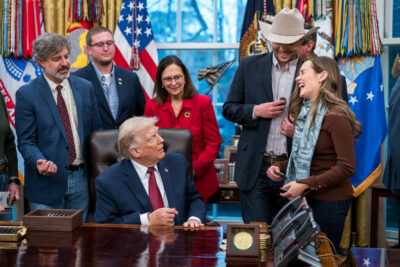
Importantly, this announcement did not come in a vacuum. In a recent cabinet room meeting at the White House, Louisiana’s Meryl Kennedy and Arkansas’s Charles Williams III, two rice industry leaders who understand both the challenges and promise of American rice, joined President Trump, Secretary of Agriculture Brooke Rollins, Arkansas Senator John Boozman, and others, to highlight the very real trade distortions undermining our industry.
Meryl and Charles underscored the urgency of addressing how countries like India and Thailand continue to manipulate the global marketplace, sidestepping commitments and flooding the world with underpriced rice. The President took note – and literally so did Treasury Secretary Scott Bessent. This was an important step in elevating the concerns of American rice farmers.
But as valuable as these bridge payments are, we cannot pretend they solve the structural issues threatening the long-term health of American agriculture. That is where the policies must catch up.
They’ve started to with the nearly 21 percent increase in the Price Loss Coverage Program reference price for rice (to $16.90/cwt) included in the One Big Beautiful Bill Act – the first update for rice since 2014. However, the first payments under these policy changes cannot be made until November 2026, after the conclusion of the 2025 crop’s marketing year. (Had we gotten a Farm Bill in 2023 as scheduled, this higher reference price would already be in place and the situation perhaps not as dire.)
Producers continue to operate in an ag economy fundamentally out of balance. Fertilizer, fuel, and chemical costs remain stubbornly high. Equipment prices are at historic peaks. Interest rates have doubled many growers’ operating loan payments. These pressures are squeezing family farms to the breaking point, and no one-time payment can offset the scale or persistence of these cost spikes.
Bridge payments may help us get across the river, but the river continues to rage. What American farmers need is a functioning marketplace, a level playing field, and policies that address root challenges rather than merely patch over them.
We appreciate the administration’s support – and the leadership shown by advocates like Kennedy and Williams. Now we must pair that support with the hard work of restoring fairness and stability to global trade, reining in soaring input costs, and ensuring that U.S. rice can remain viable and competitive for generations to come. ∆
PETER BACHMANN
USA RICE FEDERATION