Disease management in Texas rice is shaped by our warm, humid Gulf Coast climate, ratoon cropping, and evolving pest pressures. According to the Texas Plant Disease Handbook, “sheath blight, caused by the fungus Rhizoctonia solani, is perhaps the most important disease of rice in Texas.” I agree, but I also think our growers and consultants do a fantastic job managing this disease across the state. Thus, I want to highlight some emerging rice disease issues from the great state of Texas.
Kernel smut, caused by the fungus Tilletia horrida, has shifted from a sporadic issue to a significant economic problem over the past decade. We typically see kernel smut in wetter years, like we did in 2024 following Hurricane Beryl. The telltale sign of infection is black, sooty “powder” appearing in the kernels as the crop matures. The problem is that once symptoms appear, it is usually too late for treatment. Thus, a preventative approach is necessary. For more information on rice kernel smut, feel free to check out our fact sheet at https://agrilifeextension.tamu.edu/asset-external/rice-kernel-smut-factsheet/.
If it keeps raining in May and June like we saw in April, I would assume it is going to be a tough kernel smut year. It is essential to understand proper fungicide application timings for this disease since efficacy drops significantly if applied too early or too late. The optimal window for treating rice kernel smut is early to mid-boot, or when the rice has a 1- to 4-inch panicle developed inside the boot. Once the crop reaches late-boot or boot-split (panicle emergence) stages, it is usually too late.
Our best fungicide recommendation is Amistar Top (azoxystrobin + difenoconazole) applied at early to mid-boot at 10 to 15 fluid ounces per acre. I can’t stress enough that the first application is the most important and must be made on time. Additionally, in fields with a history of rice kernel smut, or in years with favorable environmental conditions like 2026, a second application approximately 14 days after the initial treatment is very common across the state. The good news is that these applications also help manage sheath blight and most of the other fungal diseases we encounter in rice.
Another sporadic disease issue that has become more noticeable in recent years is bacterial panicle blight, caused by the pathogen Burkholderia glumae (and sometimes B. gladioli). Dr. Shane Zhou, rice pathologist at the Texas A&M AgriLife Rice Research and Extension Center at Beaumont, notes that outbreaks are triggered by high nighttime temperatures, high humidity at heading, and high levels of nitrogen. Like other rice diseases, we generally see somewhat better bacterial panicle blight tolerance with hybrids. Since this is a bacterial disease, no effective chemical controls are readily available. The best recommendations at this point are to plant more tolerant varieties as early as possible and avoid excessive nitrogen. This approach also helps manage fungal diseases as well, especially when combined with fungicides.
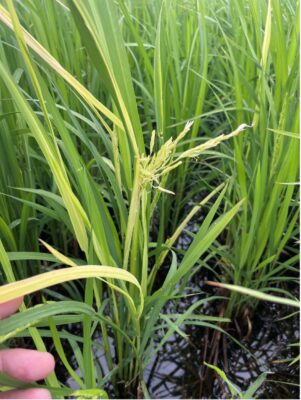
Since the rice delphacid (Tagosodes orizicolus) is such a hot topic these days, I would be remiss if I didn’t mention the rice hoja blanca virus (Tenuvirus oryzalbae). We first identified it in Texas rice in 2024 (following earlier brief appearances in the 1950s), but in 2025, I did not check a ratoon field in Texas that lacked some level of hoja blanca symptomology. Transmission of the virus occurs exclusively by the rice delphacid, so managing the insect vector is our only strategy at this point. With the new Section 18 Emergency Use Exemption for Courier Insect Growth Regulator (buprofezin) active in 2026, we should see much better control of both the insect and the virus. In addition, my colleagues Drs. Lina Bernaola, Shane Zhou, Shyamal Talukder, and Omar Samonte at the Texas A&M AgriLife Rice Research and Extension Center at Beaumont are working on resistant variety screening for both the insect and the virus, so we are hopeful we will have new management recommendations soon. ∆
SAM RUSTOM
Photo 1. Rice hoja blanca virus symptomology near El Campo, TX in 2024.
We use cookies to ensure that we give you the best experience on our website. If you continue to use this site we will assume that you are happy with it.