

Rice cultivation in the Delta now eligible for Healthy Soils Program grants
The Delta Stewardship Council has long recognized that elevation and agricultural emissions are critical issues for the Sacramento-San Joaquin Delta. In response, the Council’s Delta Plan policies and the Delta Adapts initiative have been developed to address challenges such as land loss, restoration elevations, greenhouse gas emissions, and rice cultivation strategies—all aimed at sustaining agriculture in the Delta while combating subsidence.
Over the past three decades, the Delta region has benefited from increasingly sophisticated measurements, models, and mapping tools for tracking carbon, surpassing most other estuaries in the country. These advancements continue to improve through innovative pilot projects across both public and private lands, exploring a range of management approaches. With 80% of the Delta too deeply subsided to restore to tidal marsh, rice agriculture stands out as one of the most promising interventions for reducing subsidence while preserving agricultural livelihoods.
These priorities and solutions were highlighted at the Delta Stewardship Council’s March meeting, where Dr. Nina Bingham, Senior Environmental Scientist at the California Department of Food and Agriculture, presented an overview of the Healthy Soils Program and discussed how Delta farmers can now receive an incentive through the Healthy Soils Program for switching to rice cultivation in an upcoming grant solicitation.
THE HEALTHY SOILS PROGRAM
Since 2014, the Office of Agricultural Resilience and Sustainability in the California Department of Food and Agriculture has been working to build a sustainable and thriving future for California farmers and ranchers. Much of their work is accomplished through incentive programs that encourage the adoption of climate-smart practices or the upgrade or installation of climate-smart technology on agricultural operations. The Office has awarded almost $730 million through over 4,000 projects to reduce greenhouse gas emissions from farms, dairies, and ranches, build soil carbon, improve water and energy efficiency, and bolster biodiversity, among other climate, environmental, and community benefits.
The Healthy Soils Program was established in 2017 to focus on the adoption of practices that improve soil health, build soil carbon, and reduce greenhouse gas emissions, which are critical to meeting the state’s climate goals of carbon neutrality and greenhouse gas emissions reductions by 2045. In 2022, those targets were expanded to include implementing more than 3 million new acres of healthy soil practices by 2045.
The Healthy Soils Program has three components:
-
-
Incentive grants that provide direct funding to producers for Healthy Soils practices.
-
Block grants provide financial support to agricultural operations via administrators such as nonprofits, public utilities, mutual water companies, and California Native American Tribes. These entities receive CDFA funding and distribute it to local farmers and ranchers.
-
Grants for universities, resource conservation districts, and nonprofits to research or demonstrate Healthy Soils practices and support education and outreach.
-
Technical assistance is provided throughout the components of the Healthy Soils program. “Really critical to the success of these grants is ensuring that farmers and ranchers who would like to implement these practices have the resources and the knowledge and the technology to do so,” she said.
Dr. Bingham noted the program lacks continuous funding but receives allocations from bonds like Prop 68 and Prop 4, as well as general funds and greenhouse gas reduction funding.
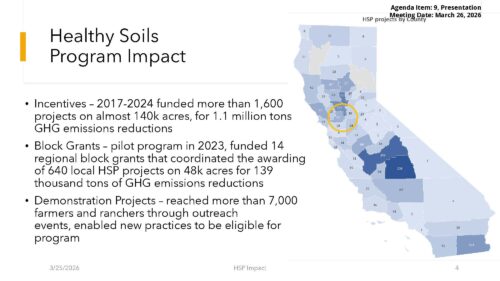 Since its first solicitation in 2017, the Healthy Soils Program has funded more than 1600 direct grower incentive projects, with another 640 projects funded through 14 block grants. More than 7000 farmers have been reached through demonstration projects and outreach events. These projects have resulted in millions of tons of greenhouse gas emissions reductions and cover almost 200,000 acres of farmland across the state. Most of the projects are in the Central Valley, the Imperial Valley, and the Delta counties.
The program periodically solicits proposals (RFPs) to identify new practices eligible for implementation funding. The proposals are reviewed by a subcommittee of subject-matter experts, who evaluate how suitable this practice would be for California, the benefits, any concerns, and what is known about its impacts on agriculture and greenhouse gas emissions reductions. The most recent round of new practices introduced to the program through this process included biochar application, prescribed indigenous burning, and a practice specific to the Delta region for saturating peat soils through rice cultivation.
RICE CULTIVATION IN THE DELTA
For thousands of years, the Delta was a tidal marsh, meaning it was regularly flooded by the tides and the rivers—the Sacramento and San Joaquin. As plants in the wetlands died, their remains, along with sediments carried by the rivers, accumulated in the marsh. Because the marsh had low oxygen levels (anoxic conditions), the organic matter from these plants didn’t fully decompose. Instead, it built up over time, forming thick layers of soil that were rich in organic material. This process created the Delta’s deep, fertile soils that are unique to the area.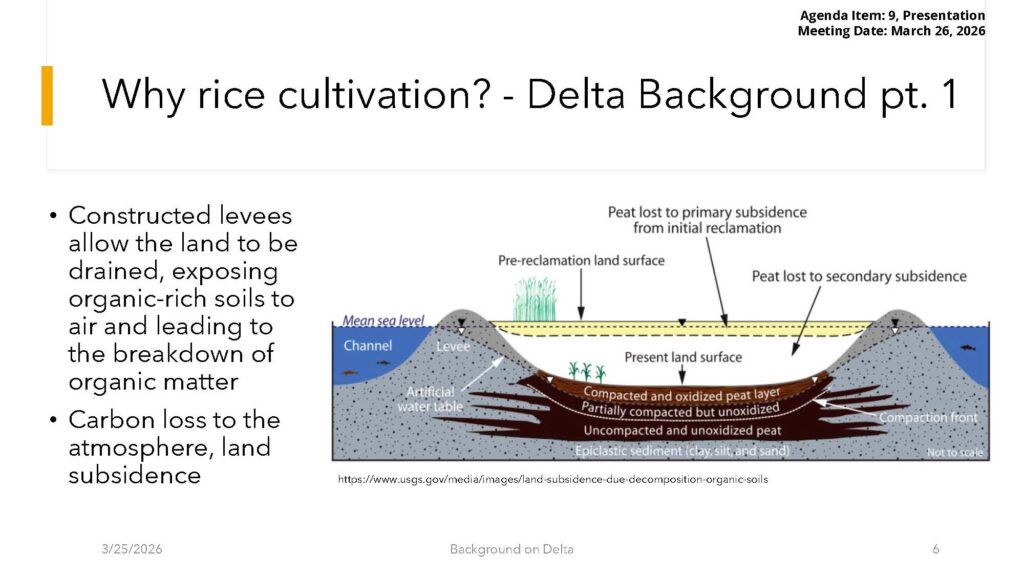
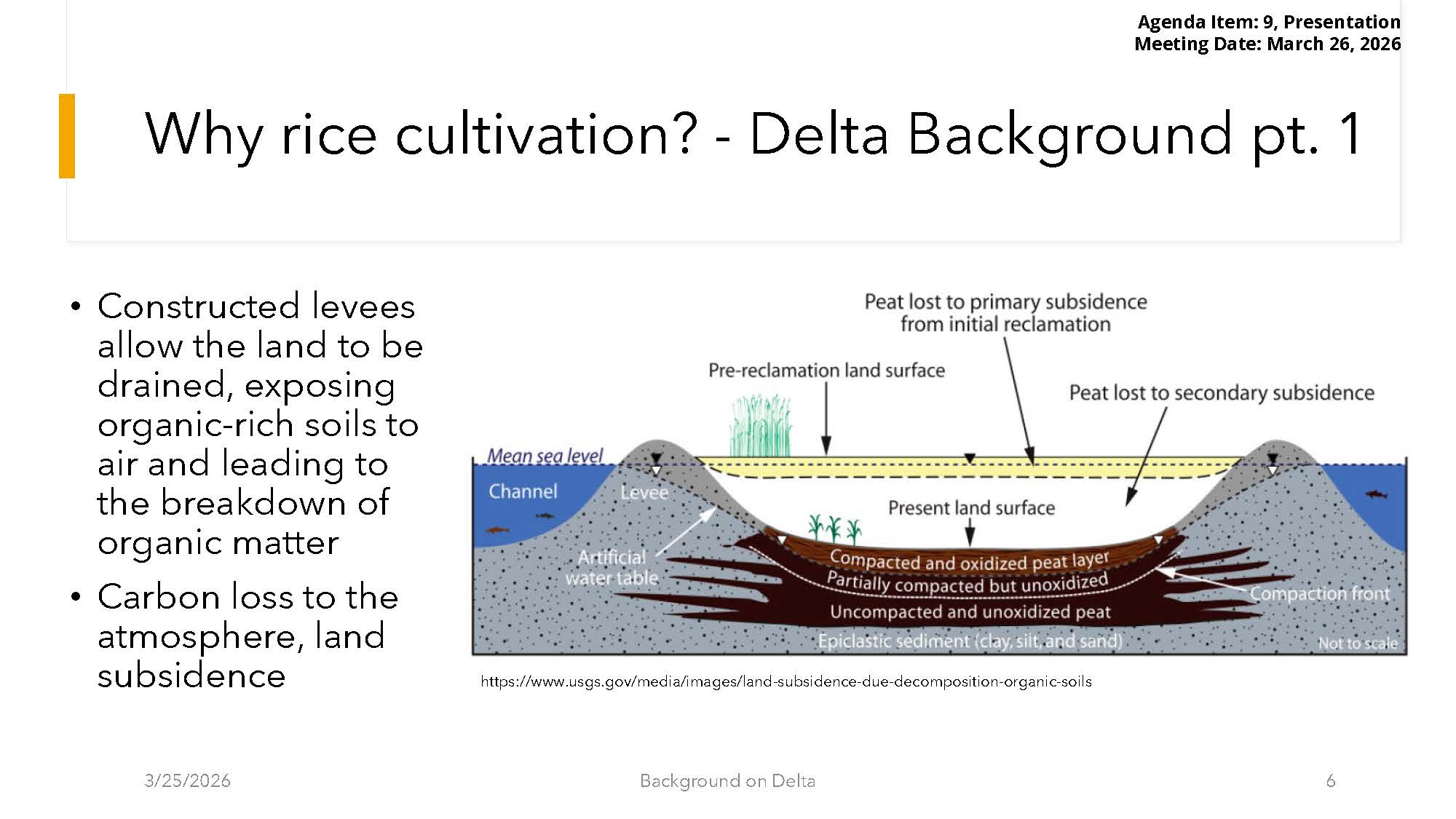
During the 1850s, levees were built, and the land in the Delta was drained to make it suitable for farming. This exposed the deep, organic-rich soils to oxygen in the air for the first time. When organic matter in the soil comes into contact with oxygen, it begins to break down, a process called oxidation. As the organic material decomposes, the soil compacts and the land sinks—a phenomenon known as subsidence. At the same time, this breakdown releases carbon dioxide (CO2), a greenhouse gas, into the atmosphere, which contributes to climate change.
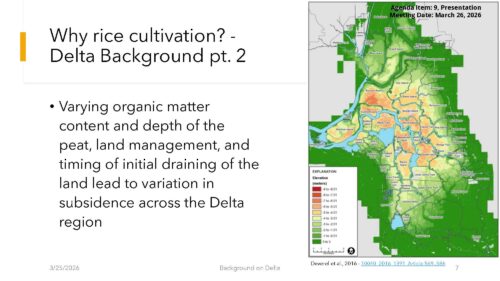 Land subsidence is not consistent throughout the Delta region. The highest rates of subsidence typically occur in areas with soils rich in organic matter, especially in the central Delta, where land elevations can now exceed 24 feet below sea level.
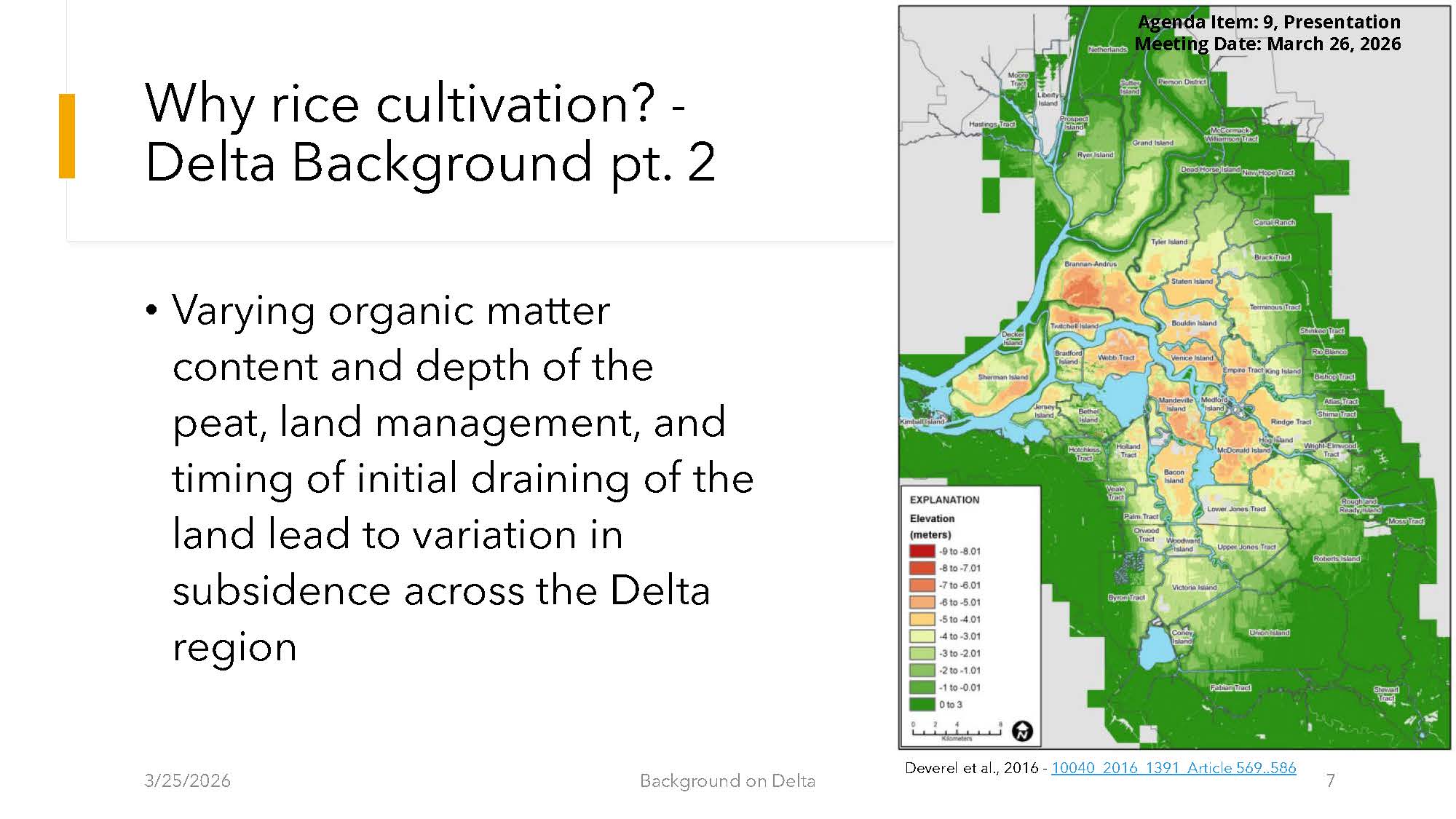
Subsidence, flooding, and rising sea levels raise the risk of levee failure in the Delta, threatening local communities and statewide water systems. Additionally, the Delta emits significant greenhouse gases due to soil oxidation across its large area.
How can we address subsidence and reduce greenhouse gas emissions, especially through approaches that support Delta communities? Since agriculture is both the primary land use and an important cultural foundation in the Delta, the Healthy Soils Program is focused on finding strategies that benefit both residents and the environment. One promising method involves rewetting the Delta’s peat soils by growing rice.
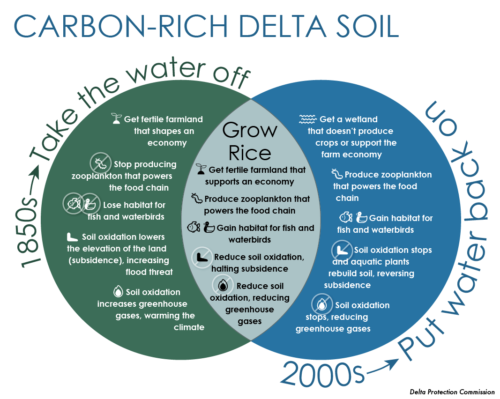
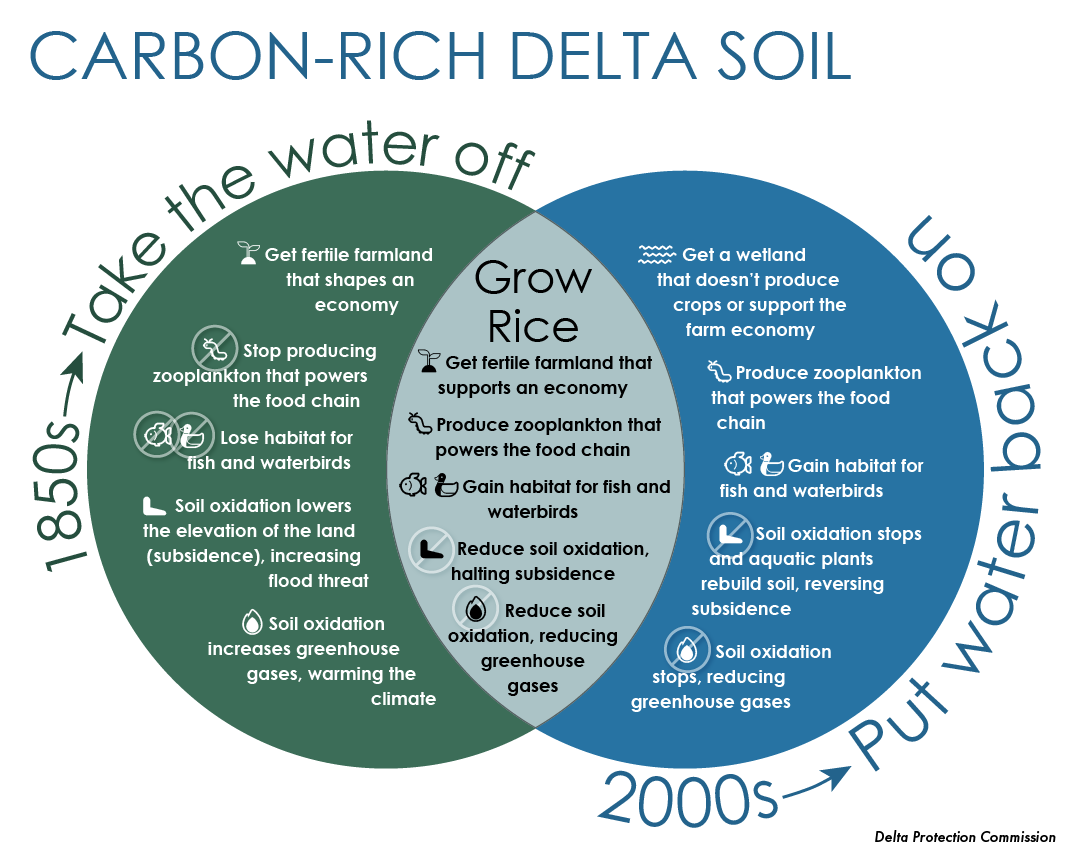
The conversion to rice cultivation in the Delta entails rewetting drained agricultural land for most of the year, initially through rice production during the growing season, followed by flooding the land for habitat in winter. This approach helps replicate the low-oxygen conditions characteristic of the Marsh prior to levee construction and land drainage. As a result, it mitigates organic matter decomposition, slows or halts subsidence, and reduces greenhouse gas emissions.
“The practice can really help stop or slow subsidence, because it’s going to stop that oxidation of the organic matter which is contributing to this subsidence,” said Dr. Bingham. “So it’s not just going to be a greenhouse gas emissions reducing process; it’s going to be a subsidence slower-stopper. There is also a wildlife benefit as the Delta serves as a major overwintering spot for a lot of birds, so we’re really excited through flooding through the winter to be able to offer that kind of habitat for birds and other species.”
 Adding a new practice to the Healthy Soils program requires collaboration with the Air Resources Board, program managers, University of California experts, other departments, conservatories, and growers to set implementation guidelines and reimbursement rates. The process starts with gathering research on greenhouse gas emissions from various Delta crops, including rice. A baseline for typical agricultural emissions from crops like corn, alfalfa, and pastureland is established and then compared with existing rice emission data. For management guidelines and reimbursement rates, they worked with the Delta Conservancy and the Nature Conservancy to learn from the Delta rice conversion incentive program that was launched in 2024.
“What we found is that growing rice creates around six tons of carbon dioxide equivalents per hectare per year of reductions in greenhouse gas emissions,” said Dr. Bingham.
The incentive program targets highly organic, nutrient-rich soils in the Delta, restricting participation to areas with soil units classified as either highly organic mineral or exclusively organic. Fields should stay flooded for roughly eight months each year, covering both the growing season and winter, to support wildlife habitats. Instead of tilling, rice straw is left on the field to improve food sources and habitat quality for local fauna. Participants will receive a one-time reimbursement of approximately $800 per acre and are expected to continue rice cultivation for at least 5 years.
The program aims to assist growers and partners in restoring the Delta’s landscape, maintaining its agricultural traditions, and improving climate resilience and wildlife habitat over time. Updated management guidelines are now available. In April 2026, the Healthy Soils Program will launch a new block grant solicitation funded by Proposition 4 in a block grant format to support healthy soil practices, including rice cultivation in the Delta.
Link to Original Article: https://mavensnotebook.com/2026/04/02/delta-council-growing-solutions-the-role-of-rice-in-restoring-the-deltas-landscape/