MARY HIGHTOWER
LITTLE ROCK, ARKANSAS
Rice growers unable to finish their initial planting are weighing whether to try again, plant soybeans, or take a prevented planting payment, extension specialists said.
The Risk Management Agency of the United States Department of Agriculture offers prevented planting provisions in insurance policies that can help farmers when extreme weather conditions keep them from planting their expected crops. Prevented planting coverage is meant to offer protection based on pre-planting costs.
Claims are subject to planting dates and late planting periods that vary by crop and by area.
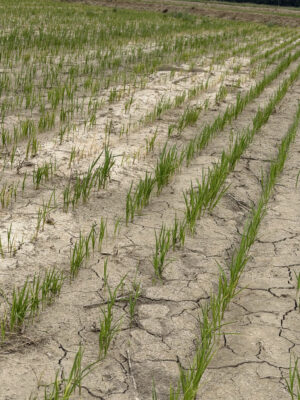
Rice growers are having to make the decision because it was either too dry to plant or when the rain did come, it became too wet to plant.
For rice, the RMA’s final planting date is May 25, with the late planting date ending June 9.
The decision, like much in farming, is a gamble.
“I think the story of prevented planting on rice surrounds the tradeoff between the prevented planting payment for rice and the expected profitability for late-planted soybeans,” said Hunter Biram, extension economist for the University of Arkansas Division of Agriculture.
Biram said he spoke with a farmer who thought about taking a prevented planting payment on ground that could also be planted to soybeans. Among the factors to consider in this decision is a farmer’s Actual Production History, or APH, which is a rolling 4- to 10-year record of a farmer’s historical crop yields, which are used to establish yield guarantees in federal crop insurance programs.
“In his mind, it was either go prevented planting with his rice or plant soybeans, which is an important distinction from prevented planting rice plus late-planted soybeans,” he said. “The latter will result in a hit to a farmer’s Actual Production History.”
First crop vs. second crop
APH is important because it is used to set insurance coverage and premium expense.
“A higher APH generally translates into a higher production or revenue guarantee,” Biram said. “If prevented planting coverage is utilized, a farmer’s APH is impacted only if they decide to plant and harvest a second crop planted after the failed attempt at planting the first crop.
“Typically, this results in about a 4 percent decline in APH year-over-year, and in the current economic downturn in the ag economy, farmers cannot afford to lose any more revenue guarantee,” he said. “While taking a prevented planting payment is sometimes necessary due to extreme weather, like the flood event of April 2025, it is usually better to attempt to plant and harvest the first intended crop.”
“At the end of the day, it is important to know the yield potential for ‘second crop’ soybeans which tend to be late planted soybeans, or soybeans planted later than the optimal planting window,” Biram said. “As yield potential falls, so does profit potential.”
Prevented planting is not an all-or-nothing scenario.
“A farmer can take prevented planting and not plant anything after and receive the full payment,” Biram said. “A farmer can also take prevented planting, and plant and harvest the second crop.
“However, in the second case, a farmer can only take 35 percent of the first crop PP payment paid at 35 percent of the first crop premium expense, and they will take a hit on the first crop APH,” he said. “This second option is not used much, but it is available. Most farmers just take the prevented payment on the first crop and leave the ground fallow.”
Cotton window closing
Some Arkansas cotton growers may find themselves in the same boat as rice growers as the planting window closes. The crop was 77 percent planted, according to this week’s Crop Progress report from the National Agricultural Statistics Service.
“We’re now beyond the crop insurance final planting date for all counties,” said Scott Stiles, extension economics program associate for the Division of Agriculture. “Considering how much rain we’ve had – and may get more this week – it will be early June before fieldwork resumes in northeastern Arkansas.”
The final planting date for cotton varies by county.
-
May 20 is the final planting date for northern counties, those generally north of I-40.
-
May 25 is the final planting date for all other counties, those generally central and southern Arkansas.