Rice Processing Research Points To Evolving Milling Rates As Quality Factor
Research suggests commingling certain cultivars is a source of decreased head rice yield
JOHN LOVETT
FAYETTEVILLE, ARKANSAS
Research by the Arkansas Rice Processing Program is showing valuable insights for rice farmers that affect their take-home pay and the quality of rice for food makers.
Over the past two years, in cooperation with the global food corporation Mars and several rice farmers in Arkansas, researchers with the Arkansas Agricultural Experiment Station’s Rice Processing Program have dug into the problem with declining head rice yields, or the total weight of unbroken rice kernels after milling.
All signs point to the effects of commingling cultivars with variable milling rates as a primary cause for lower head rice yields, said Griffiths Atungulu, an agricultural engineer, professor of food science and director of the Rice Processing Program for the experiment station, the research arm of the University of Arkansas Division of Agriculture. Atungulu is also part of the Dale Bumpers College of Agricultural, Food and Life Sciences at the University of Arkansas.
“In general, head rice yields have been declining over time,” Atungulu said. “Rice acreage has also decreased. However, grain yield per acre has continued to increase, particularly with the adoption of hybrids.”
Milling rates evolve
While it was known that different rice cultivars have different milling rates, Atungulu said the rates are constantly evolving with the development of new varieties that improve yield and environmental adaptation. Milling rates are dictated by bran layer thickness, other husk characteristics and sometimes the inherent resistance of cultivars’ rice kernels to breaking.
To obtain representative data for the two major rice-growing regions of Arkansas, the research included the most popular rice varieties grown in the state on test plots at the Division of Agriculture’s Rice Research and Extension Center in Stuttgart and Northeast Rice Research and Extension Center in Harrisburg.
Be aware of cultivar milling rates
Bigger yields out of the field do not always translate to higher head rice yields, Atungulu said.
“We are showing here, very clearly, that we need to be very aware of the milling rates of different cultivars,” Atungulu said. “Some cultivars tend to mill faster and some mill more slowly. If you are going to do a commingling, then you want to commingle them in a manner that they are going to mill at the same rate.”
Some cultivars are more sensitive than others to milling, he noted, but over-milling by even 0.1 percentage point of surface lipid content, which indicates the degree of milling, can happen in seconds and cause a nearly 2 percent drop in head rice yield, he said.
“This is something that mills, if they are aware, can make room for, whenever possible,” Atungulu said. “We need to do identity preservation, and you will not hurt your mill’s milling rates. And then it’s better for them, better for the farmer, and the consumer. However, it is understandable that challenges can sometimes arise in practice when multiple varieties arrive at the mill simultaneously.”
Continual evaluation is necessary
Kaushik Luthra, an assistant professor in the department of biological and agricultural engineering and extension engineer at the Northeast Rice Research and Extension Center, has been a part of the studies in both his current role and previously as a postdoctoral fellow working with Atungulu. He works closely with farmers and industry partners to translate the research findings into practical strategies that improve rice quality and profitability.
“I have seen firsthand how differences in milling rates among cultivars can significantly impact head rice yield and commingling is a critical factor,” Luthra said. “I strongly agree with the emphasis on addressing commingling as a critical factor. It is also encouraging to see the end-use companies like Mars taking the lead in addressing these challenges.”
Some of the research into commingling different rice varieties overlapped with project funding from the Arkansas Rice Research and Promotion Board, Atungulu said, to address concerns over milling yields, which includes the weight of both whole and broken kernels after milling.
“We put the two projects together,” Atungulu said. “The continual evaluation and understanding of these dynamics are very important for the industry.”
Abhay Markande, principal scientist and manager of Mars Food and Nutrition’s rice program, said the research collaboration demonstrates how land-grant university research and industry engagement can drive lasting change in rice production and performance.
“What began as a research collaboration has evolved into a unified, science-led movement that strengthens resilience and unlocks future growth in rice,” Markande said.
The joint research is “delivering measurable impact that demonstrates how harvest conditions and rice variety influence head rice yield and end-use performance,” he added. ∆
JOHN LOVETT
UNIVERSITY OF ARKANSAS
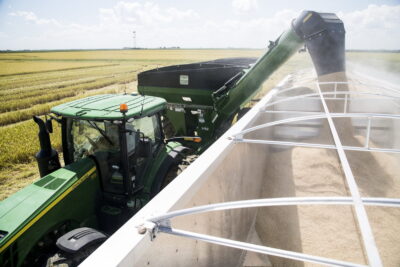
Research points to commingling rice varieties with different milling rates as a source of decreased head rice yields in Arkansas despite the increase in grain yield per acre. (UADA photo)
Griffiths Atungulu, professor and director of the Arkansas Rice Processing Program, has worked with Arkansas farmers and the global food company Mars to investigate reasons for falling head rice yields. (UADA photo)

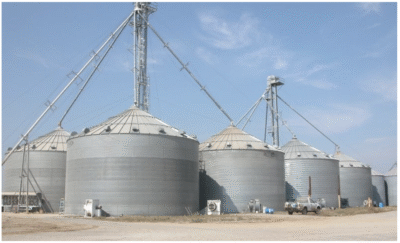
Farm silos are used to store grain after the harvest to improve marketing flexibility and begin the drying process to an optimal range of 12.5 percent. Low moisture content at the time of harvest can impact quality. (UADA photo)
Link to Original Article: https://aaes.uada.edu/news/rice-milling-research/