JOHN LOVETT
FAYETTEVILLE, ARKANSAS
Rice plants and Venus flytraps share something in common that was not scientifically documented until recently.
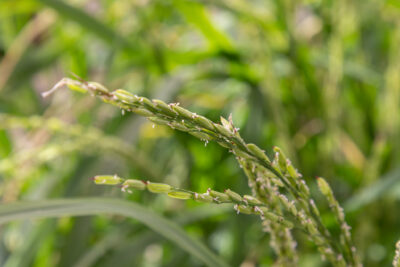
Using a faint smell to lure caterpillars into a trap, rice plants kill early-stage fall armyworm larvae by trapping them in a spikelet, the part at the end of a rice panicle where individual grains develop.
In its flowering stage, the spikelet opens to expose a floret for pollination. Covered in spike-like hairs called trichomes, the spikelet slowly closes on the caterpillar stuck on the barbs.
Like many great moments of scientific discovery, the observation that led to the finding was unexpected for Devi Balakrishnan.
“This was not in the plan,” said Balakrishnan, Ph.D., in the department of entomology and plant pathology for the Arkansas Agricultural Experiment Station, the research arm of the University of Arkansas Division of Agriculture. “I was doing another experiment on rice with fall armyworms and started noticing these caterpillars were inside the spikelet, and they were dead.”