

Specialists Speaking – SAM RUSTOM – TEXAS
Background
Over the past 10 years, rice delphacid (Tagosodes orizicolus) has become the No. 1 crop management concern for Texas rice producers. Native to Central America, South America, and the Caribbean, we think this pest could have caught its initial ride to Texas with Tropical Storm Bill back in 2015. A couple of months after Bill, consultants first reported rice delphacid damaging rice in Galveston and Matagorda Counties.
From 2015 until 2020, infestations were inconsistent and populations were variable across the state. By 2022, rice delphacid in the ratoon crop pretty much became a permanently budgeted item for most of the growers across the south and west sides of Houston. Keep in mind that this has only been a ratoon pest up until this point and was typically a September-October issue.
Fast forward to Hurricane Beryl, which hit July 8, 2024. By the end of the month, we were getting a few reports of rice delphacid causing main crop damage for the very first time. This was not a widespread issue and only happened in a few fields around the state, so we wrote off the first ever main crop appearance as a function of the hurricane. Damage in the ratoon crop in 2024 was a different story, rivaling the damage we saw in 2022, making these two of the worst years the state has seen up to this point in time.
Although we dodged hurricane activity in 2025, rice delphacid showed up in early June during main crop production, nearly a month earlier than what we saw 2024. The difference is, by the end of June or early July, there was not a rice field south or west of Houston I walked in that did not have rice delphacid present. In our economic analysis, we estimated Texas lost around 8% of the main crop in 2025. This was also the year that the pest became a multi-state issue, with positive identification and damage reported in Louisiana, Arkansas, Mississippi, and North Texas. Yes, we do have one rice farmer in North Texas on the Red River looking into Oklahoma, and his main crop damage was among some of the worst I have seen.
With a growing population already present in the main crop, the ratoon crop of 2025 was one of the biggest challenges in Texas rice history, especially with market conditions combined with the pest. Rice struggled during the tillering and reproductive stages as the pest was relentless across the rice belt. When it was all said and done, we ended up losing 43% of our statewide ratoon crop, 25% of which was completely abandoned due to intense rice delphacid pressure. The rice we actually harvested at ratoon took a 36% yield reduction when compared to the growers’ historic averages.
Photo 3. Severe rice delphacid damage near Brookshire, TX.
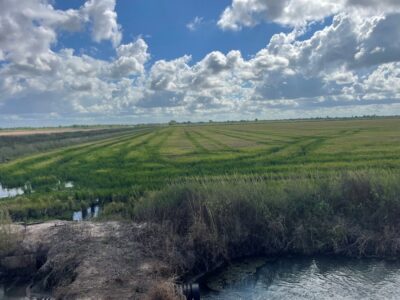
Rice delphacid is a planthopper that we typically find on field edges first, then we will see populations build in the middle of the field if not treated. This is especially true in areas of the fields where the rice canopy is most dense. Oftentimes, fields where we first find them are adjacent to tree lines, wetlands, or duck ponds.
Photo 1: Rice delphacid female adult (top) and male adult (bottom). Photo: Dr. Tyler Musgrove
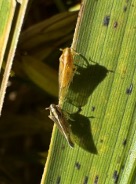
Key identifying characteristics for identifying adults:
- Size – around ¼ inch long, slender bodied.
- Males are dark brown to black, often with spots on wing tips.
- Females are straw to tan color and often slightly larger than males.
- Some females have a short-winged morph with a swollen abdomen.
- Wings are held tent-like over the body. The long-winged forms are most common.
- Both sexes typically show a yellow-to-white dorsal stripe running down the back.
- A large, movable apical spur is located on the hind legs.
Photo 2: Rice delphacidnymph. Photo: Dr. Dawson Kerns
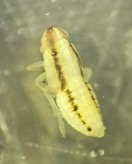
Key identifying characteristics for identifying nymphs:
- Wingless, though later instars develop wing pads.
- First instar nymphs are tiny at hatching, typically the size of the tip of a pen.
- First instar is pale white, later instars are yellowish white.
- Later instars develop dark brown to black longitudinal stripes, often described as racing stripes, running along each side of the abdomen.
- Often found at the base of the plant near the water line using piercing-sucking mouthparts to feed on sap.
What are we doing now?
Luckily, we have a fantastic group of entomologists and Extension rice specialists across the Mid-South who came together in 2025 to put in the work to evaluate any insecticides we could. While most of the products we looked at weren’t perfect, there was one that stood out: Courier SC (active ingredient: buprofezin). Courier is an insect growth regulator that provides fantastic control of rice delphacid nymphs and is used in several countries in Asia and Latin America. Right now, we think the nymphs are causing a large portion of the damage, considering they are flightless and their only job is to sit in rice and fill their bellies with the precious sugars that should be filling grain.
Courier will serve as the backbone for rice delphacid management in Texas in 2026. Further research will be conducted to determine tank-mix partners for adults when populations are high, but our preliminary data suggests that the addition of Courier to the system will help manage the pest by breaking up the reproductive cycles in the field. Since there are no established thresholds and this pest can reproduce rapidly, we are encouraging growers to apply Courier at first detection in Texas. In addition, some growers will likely be using Courier preventatively by applying it with their fungicide application at late boot.
I view Courier as a fantastic tool that will help bridge the gap while long-term solutions to manage both nymphs and adults are developed. We still have work to do, considering there are no labeled options for adult rice delphacid management that work very well. For now, we are encouraging growers to add Endigo ZCX to the tank with Courier if adult populations are high at application. I know this isn’t perfect because of the pyrethroid component, but it is the only option we have at this point. ∆
SAM RUSTOM
TEXAS