
Dwight Roberts / Former President and CEO US Rice Producers
Most of you will remember crop year 2010, a year seen by many as a turning point for U.S. rice. The third largest planted acreage of long grain in U.S. rice history with a season of intense heat with high nighttime temperatures became the start of a process that at first slowly changed the export market for U.S. rice farmers. In the years ahead this process fully exposed a problem with grain and cooking quality especially in the foreign marketplace, particularly Mexico, the Caribbean and Central and South America. We made field yields more important than grain quality, not equally important and the U.S. has paid dearly for that mistake. While the USA Rice mills’ leadership formed a grain quality task force some 15 years ago, nothing was accomplished. At their outlook conference in Little Rock in 2014, USA Rice made a commitment to the Central American Rice Federation of “we understand, we can change their minds and get them all back in the U.S. rice camp”. “Our meeting with Central America was an excellent step” was stated. It was merely chest pounding, back sale to farmers. The process got worse.
Maybe USA Rice should make a trip to Mercosur (Argentina, Brazil, Paraguay, Uruguay) and see for themselves what it is about their rice that has allowed them to gain such a large share of a market that once belonged to the U.S., 99% at least!!! Along came the CAFTA-DR free trade agreement and that is another story that farmers need to understand. Even better, go ask Costa Rica, Venezuela, Peru, Panama, and the other markets why they no longer prefer U.S. rice. Really the ideal activity is to attend the annual Rice Market & Technology Convention where all the principal exporters and importers of rice in the Western Hemisphere attend from some 35 countries. The U.S. rice industry can no longer allow arrogance to keep them from learning reality and attend this event so popular with so many important rice companies.
We cannot over emphasize enough the importance of the export market and its impact on prices for U.S. rice farmers. The graphs below are self-evident as they show the disconnect between milled rice and the price paid to farmers. It is not the retail market that sets the price, it is the export market.
The issue is really not complicated but for now we have a commodity instead of a product. And even with low prices, below the cost of production, we are at a 30-year low for exports, which directly affects farmer’s prices. So again, the farmer’s price is completely dependent on the export market price and that is based on demand.
If we are to get higher prices, we need to increase export demand and to do that, we need to sell what the buyer wants. That is not what we have been doing.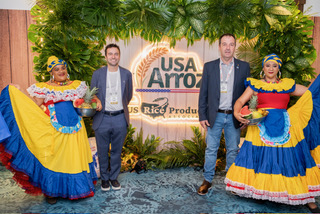
Alexandre Velho (right), President of Brazil’s Instituto Rio Grandeese de Arroz (IRGA) along with Juandres Antunes, Director of Marketing at the USRPA’s rice convention in Cartagena, Colombia in May. IRGA is credited with the development of popular rice varieties preferred by Central American an other markets.
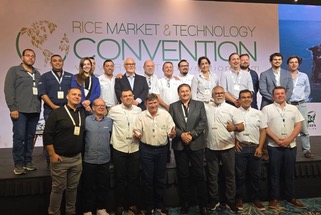
Paraguay only began producing a serious volume of rice in the past 20 years and have become an important exporting country of both rough and milled rice, principally grower the popular Brazilian-IRGA varieties. Every year they have a strong presence at the Rice Market & Technology Convention.