By Dennis DeLaughter, Senior Market Analyst for US Rice Producers Association
The rice market is increasingly becoming a story of two very different fundamentals. In the United States, sharply lower production has created a relatively tight domestic balance sheet while at the same time, the global market continues to face massive supplies, large government-held inventories and intense export competition. For U.S. producers of long-grain, understanding the difference between these two markets may be one of the most important factors determining prices during the coming year.
The tightening U.S. situation is largely the result of acreage. USDA currently estimates 2026 U.S. long-grain rice production at only 103.5 million hundredweight, the smallest crop since 1987/88. Harvested long-grain rice acreage is estimated at only 1.391 million acres, the lowest since 1972/73.
The smaller crop is expected to significantly reduce inventories despite unusually large beginning stocks. USDA projects 2026/27 long grain rice ending stocks at 21.4 million cwt, down 49 percent from the previous year. The agency has responded to the tighter supply outlook by forecasting an long-grain rice season-average farm price of $13.50 per cwt, roughly 30 percent above 2025/26 and most analysts believe that average price will be much higher.
Viewed strictly from the U.S. balance sheet for long-grain, these numbers appear constructive. But rice does not trade in isolation.
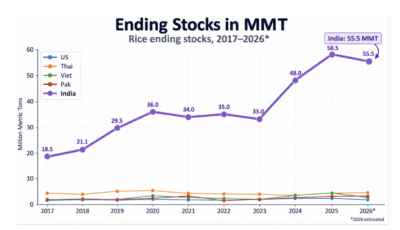
Outside the United States, the supply picture looks considerably different as India remains the most important piece of the oversupplied world equation. The USDA projects global rice supplies at nearly 196.9 million metric tons on a milled basis, supported by enormous carry-in inventories in two major countries. China and India. China is not a large exporter as they export only 2.2 million metric tons which is 1.5% of what they produce and is a lower export number than the United States. This compares to India which exports 25 million metric tons per year while the USDA projects their carryover to be 55.5 million metric tons at the end of the 26/27 crop year. That is over double what they will export.
The issue regarding oversupply in the global market rests at the feet of India. Non including China which again is a net importer of rice, India alone is expected to account for roughly 62 percent of the total world rice inventory in 2026/27 and is forecast to have 84% of the total stocks held by major exporting countries at the end of the year. Those stocks provide India with tremendous flexibility in both domestic policy and export pricing since the WTO considered them a “developing” nation.
This overbalance of rice stocks has the Asian exporters of Thailand, Vietnam, Pakistan and others – in direct competition for the global export market and is keeping world prices far below production costs. Recent comparisons to India’s price at $365/ton suggests their farmers are getting $8.40 per cwt before government support. That support is the problem.
This creates the central problem facing the U.S. rice industry as domestic scarcity does not mean equal international scarcity.
The United States may need higher prices to ration a smaller domestic crop and encourage additional acreage in 2027. However, higher U.S. prices can also widen the price difference between U.S. rice and competing origins, especially in Asia, making it more difficult to maintain exports in price-sensitive markets.
However, India is the swing factor for how long the disconnect persists. India’s food inflation has already been ticking higher — 5.52% in July — and a weaker monsoon adds pressure on the Reserve Bank of India’s policy calculus. If domestic inflation concerns push New Delhi toward tighter export controls, the global cushion that’s currently holding world prices down could erode quickly — a genuine upside risk for global (and by extension competing-origin) rice prices that is not in the current numbers.
That tension could define the year ahead. The U.S. market has legitimate reasons to command a premium, but the world market may place a ceiling on how large that premium can become.
In short, U.S. rice producers are operating in a tight market inside an oversupplied world. The battle between those two fundamentals may ultimately determine price direction.
Source note: USDA Economic Research Service, Rice Outlook, September 2026. Mathematical Models based on $585/MT US price vs $365/MT price in India.
We use cookies to ensure that we give you the best experience on our website. If you continue to use this site we will assume that you are happy with it.